Susie Q’s house
How to Flirt with A Naked WerewolfSusie Q’s house is the setting of Susie Quinn’s mauling and the principal human location through which Grundy tries to understand the wolf threat. Its yard supplies the only immediate physical evidence after the attack, while the house’s later place on the wolf’s recurring route links a private domestic space to a danger that the town cannot see, predict, or contain.
The Attack and Its Immediate Evidence
Susie Q’s house is associated above all with the nighttime attack that leaves Susie in intensive care. She suffers extensive damage to her trachea and jaw, broken ribs, internal injuries, and the loss of two fingers from her right hand while trying to fend off the wolf. The doctors cannot say whether she will ever speak again, and her inability to communicate reduces her account to a few words for state police: “big wolf bit me.” The house therefore becomes the starting point for an investigation in which the victim’s testimony is both devastatingly clear and frustratingly incomplete.
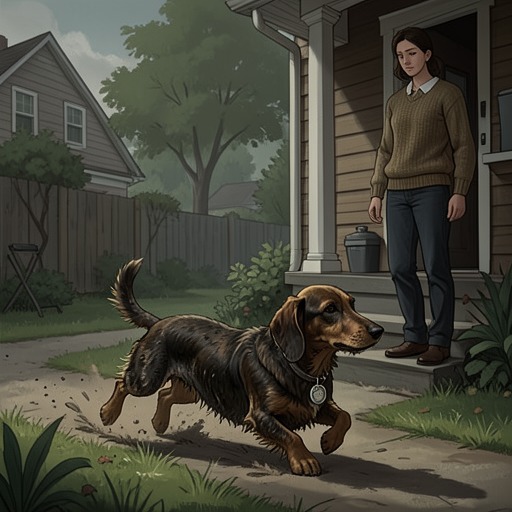
The property also functions as a contested evidentiary space. While caring for Oscar in Susie’s yard, Mo searches along the perimeter for proof that Cooper is innocent of the mauling. Near the driveway, she finds enormous paw prints pressed into the mud. They are large enough to be Cooper’s, but they might equally belong to a bear, so the tracks establish suspicion without resolving it. Mo’s crouched examination of the prints is interrupted by Cooper, who finds her looking for evidence that could implicate or exonerate him. The yard thus stages the tension between intimate knowledge and material proof: Mo knows Cooper closely, yet the tracks seem capable of making an accusation independent of personal trust.
Investigation and the Missing Trail
The attack at Susie Q’s house prompts a wider search for signs of a dangerous animal. Alan consults an expert in wolf behavior at ASU, who explains that an attack on a lone, defenseless person may occur when a wolf is sick or wounded, but that such behavior is usually preceded by indications that wolves are approaching town, including livestock deaths and missing pets. No such broader pattern has been reported. The lack of warning signs makes the house an isolated point of violence rather than one visible episode in a conventional predator incursion.
The physical trail from the property proves equally unstable. The paw prints disappear a few miles into the woods, leading Alan to joke that the wolf might have sprouted wings and flown away. He spends weeks tracking what he calls “Susie Q’s wolf,” finding signs that circle through Grundy but no animal remains, scat, continuous trail, or actual wolf. The investigation therefore expands geographically while remaining evidentially empty. Susie’s house is the fixed origin of the search, but the wolf refuses to remain attached to a single route or recognizable body.
The House on the Wolf’s Route
Alan’s tracking repeatedly brings him past Mo’s house, an unsettling pattern he cannot explain. He tells Mo that he has never seen anything like it and describes her home as lying on a kind of “wolfy scenic route,” despite her having seen no wolf there. The recurrence creates a concealed spatial link between Susie Q’s house, the surrounding woods, and Mo’s domestic life. Although Alan reads the pattern as a tracking anomaly, Mo understands more than she can safely reveal and even notices Cooper parking near her house while trying to maintain an ordinary conversation.
This route gives the location significance beyond the attack itself. Susie Q’s house is not merely where a victim was found; it is the point from which a threatening presence radiates through the town, crossing yards, streets, and forest edges without leaving enough evidence for official certainty. The repeated movement toward Mo’s home also foreshadows the conflict between the public theory of an unknown wolf and Mo’s private suspicion that Cooper may be connected to the animal.
Community Meaning and Aftermath
The house becomes part of Grundy’s effort to resume ordinary life after a crisis that cannot be repaired. Susie’s injuries are severe enough to alter the town’s routines and remove her from the postmaster’s role, which Gertie assumes in her absence. Yet the town continues preparing for the Big Freeze, intending to place Susie’s picture on the bar with a candle and her favorite beer. Susie Q’s house consequently stands for both the violence inflicted on one resident and the community’s improvised ritual of continuity: people acknowledge the catastrophe, then return to work, food, parties, and local habits because no further immediate action seems possible.
Its narrative importance lies in this unresolved conjunction of home, evidence, and secrecy. The house is a domestic setting breached by the wolf, a crime scene whose tracks cannot establish the culprit, and a landmark in the invisible circulation of the creature around Grundy. Through it, the story contrasts the vulnerability of an apparently protected resident with the limits of policing and scientific prediction, while making the town’s ordinary geography carry the pressure of a hidden supernatural conflict.